Read My Heart by Jane Dunn
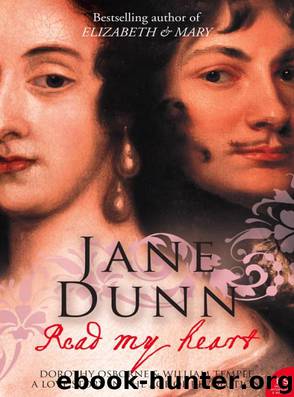
Author:Jane Dunn [Jane Dunn]
Language: eng
Format: epub
ISBN: 9780007373260
Publisher: HarperCollins Publishers
* * *
* Richard Cromwell (1626–1712), fourth child and elder surviving son of Elizabeth Bourchier and Oliver Cromwell. Succeeded his father as lord protector in 1658. He fled abroad when the protectorate collapsed and remained in exile, separated from his wife and daughters, until 1680. On his return he lived quietly at Cheshunt under the assumed name of John Clarke. There were certain rumours of his homosexuality.
* George Monck (or Monk), general and 1st Duke of Albemarle (1608–70), a Devon man and a professional soldier of genius who served Charles I loyally until captured in 1644. Refusing to change sides, he was imprisoned in the Tower. After the first civil war he accepted a commission with the parliamentary forces, proving his loyalty and military prowess in Ireland, Scotland and the first Dutch war of 1652–4 when he was appointed general-at-sea. Trusted by Oliver Cromwell, supportive of his son, he marched his troops south during the confusion that followed Cromwell’s death and Richard’s abdication. He became the natural kingmaker, ordering the reinstatement of the unpurged Long Parliament, spurning absolute power for himself and opening negotiations with Charles II. He was the first to welcome the king when he landed at Dover. The army he had marched down from Coldstream in Scotland became the Coldstream Guards and his distinguished military career continued with the second Dutch war, 1665–7. He took charge of London during the emergencies of the Great Plague and Great Fire. He died full of honours, was given a state funeral and buried in Westminster Abbey.
* James Butler, 12th Earl and 1st Duke of Ormonde (1610–88), part of a leading family of the old English elite in Ireland owning much of Kilkenny. Loyal royalist, he was lord lieutenant of Ireland 1643–7 and 1649–50. After Cromwell’s Irish campaign he went into exile with Charles II and was involved in the negotiations to restore the monarchy. He returned to Ireland as lord lieutenant and was awarded his dukedom in 1661.
* Richard Allestree (or Allestry) (1619–81), religious writer, regius professor of divinity at Oxford and provost of Eton College. A man of intellect, action and administration, he helped maintain Church of England services in the interregnum years. His writing was mostly anonymous but The Whole Duty of Man (1858), which may have been a collaborative work with Lady Dorothy Packington, was very influential in laying out the ideals for an orderly Protestant life. He is buried in the chapel at Eton.
* John Fell (1625–86), classicist, philologist, writer, publisher, ecclesiastical builder and educator, eventually Bishop of Oxford (1676). Royalist soldier and then activist on behalf of the Church, University of Oxford and the university press, he built great buildings, was a moving force in every area of Oxford institutional life and was an inspirational teacher and disciplinarian, using epic tasks of translation as punishment for his wayward students. His publications and translations were numerous and he died, it was said, of overwork.
* Henry Bennet, 1st Earl of Arlington (1616–85). Scholarly as a young man, he fought for Charles I during the civil wars and spent some time in exile with Charles II.
Download
This site does not store any files on its server. We only index and link to content provided by other sites. Please contact the content providers to delete copyright contents if any and email us, we'll remove relevant links or contents immediately.
| Africa | Americas |
| Arctic & Antarctica | Asia |
| Australia & Oceania | Europe |
| Middle East | Russia |
| United States | World |
| Ancient Civilizations | Military |
| Historical Study & Educational Resources |
Room 212 by Kate Stewart(5119)
The Crown by Robert Lacey(4814)
Endurance: Shackleton's Incredible Voyage by Alfred Lansing(4780)
The Iron Duke by The Iron Duke(4354)
The Rape of Nanking by Iris Chang(4211)
Joan of Arc by Mary Gordon(4109)
Killing England by Bill O'Reilly(4001)
Say Nothing by Patrick Radden Keefe(3983)
I'll Give You the Sun by Jandy Nelson(3445)
Shadow of Night by Deborah Harkness(3366)
Hitler's Monsters by Eric Kurlander(3341)
Mary, Queen of Scots, and the Murder of Lord Darnley by Alison Weir(3210)
Blood and Sand by Alex Von Tunzelmann(3203)
Eleanor & Park by Rainbow Rowell(3169)
Darkest Hour by Anthony McCarten(3129)
Margaret Thatcher: The Autobiography by Thatcher Margaret(3081)
Book of Life by Deborah Harkness(2937)
Red Famine: Stalin's War on Ukraine by Anne Applebaum(2932)
The One Memory of Flora Banks by Emily Barr(2862)
